

Four Core Competencies
Evidence from hundreds of interactions in discussions during 36 recent typical projects has repeatedly shown that project professionals use four core techniques or strategies to establish, protect, and revise the valued goals normally associated with sustainability.
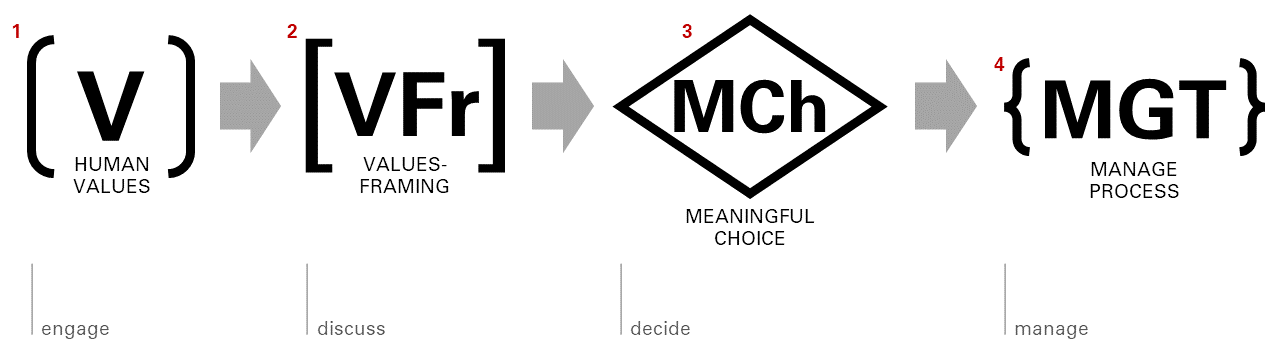
We reconceptualised these strategies as four core competencies of professionals operating in today’s increasingly challenging business climate, representing four steps in order of their use:
- Creating Value-via-Values
- Communicating better through Values-Framing
- Making individually meaningful choices through values-based decision-making
- Managing sustainability through decision processes, by harnessing Values-and-Frames.
Scroll down to learn more, and contact us for even more.
STEP 1 Creating Value-via-Values
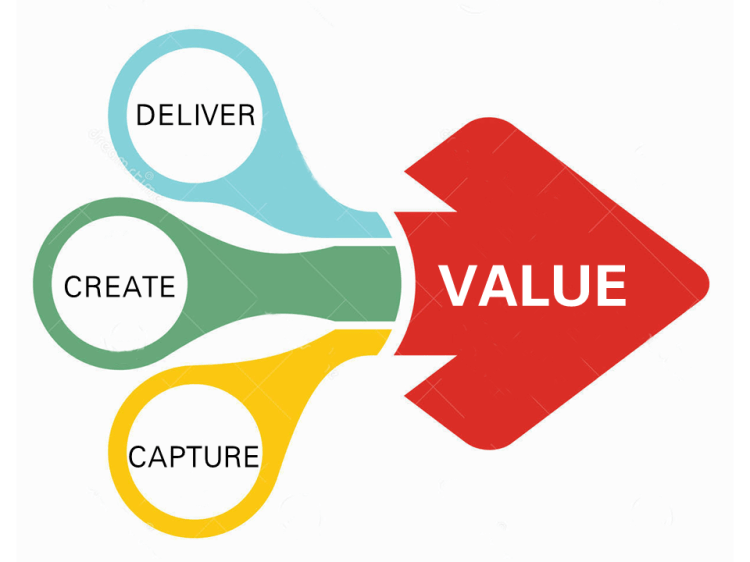
Creating value for clients and stakeholders — a central goal of any project — first involves establishing what constitutes a project’s value, or its’ meaning and measurement. Research has demonstrated that the most meaningful aspects of the value of project sustainability are those directly responding to, or informed by, stakeholder’s human values.
Creating Value-via-Values therefore involves recognising and linking sustainability to our own human values and to those of your clients and stakeholders. In this way, the shared, values-based vocabulary that arises thus provides you with the foundations to establish, protect, and revise the valued project goals — which can now be reassociated with sustainability through techniques called framing and reframing, the second Core Competency below.
The first step in creating Value-via-Values involves recognising and creating values-based vocabularies for project value, the subject of this first Core Competency. The second step involves using that values vocabulary to look at project sustainability with a values lens, then potentially recasting or reframing sustainability in values terms — the subject of the second Core Competency below. Worked examples are found throughout the ‘How to’ Guides.
This core competency responds to the first and second main challenges and the first core component to build more meaningful futures: Human Values.

STEP 2 Communicating better, by Values-Framing
Communicating better involves creating better ‘frames-of-reference’ by using values-based language (established in Step 1 above). Frames help us structure and communicate our thoughts and ideas in a specific way. For instance, framing sustainability regulations as goals or targets will set them up as the endpoint towards which a project should aim, but no more, using what’s called a goal frame. This frame resonates with stakeholders who have conservative and self-enhancing values that dominate their thinking and decision-making.
However, framing sustainability regulations as starting points sets them up as the beginning minimum from which a project can increase and go beyond, using a baseline frame. This frame resonates with stakeholders who have progressive and self-transcending values.
But by inverting this process and finding out what stakeholders’ values are first, and then reframing sustainability in terms of those values (or concepts which would relate to or satisfy those values), we take out the guesswork and make sustainability more individually meaningful from the start.
For instance, if a client values saving time and money, then framing any building fabric enhancements like superinsulation or sustainability features like green roofs and wind turbines in terms of long-term cost savings and time-saving in overall maintenance (conservation frames) resonates with them because they are framed in their values terms and are therefore likely to result in supportive decisions that withstand future challenges. Many more examples can be found in the ‘How to’ Guides.
Thus, frames are critical to establishing the meaning and worthiness of sustainability in each project’s context. Framing, as the act of creating frames, is fundamental for setting the stage for sustainability and making it more individually meaningful during decision-making, the third step below.
This core competency also responds to the first and second main challenges and the second core component to build more meaningful futures: Communication Frames and Framing.

STEP 3 Making Individually Meaningful Choices
Values-based decisions are more individually-meaningful and therefore much more likely to withstand project variations. Project professionals can help stakeholders consistently make more individually-meaningful choices by reconsidering project goals, reasons, and options for pursuing sustainability in terms of stakeholders’ human values through Values-Framing, as above. By making choices that are motivated by one’s own human values in context, reasons to later retain that decision can be linked to those values, which, by their very nature, are foundational and motivating.
However, as projects become ‘more real’ over time, research has repeatedly demonstrated that the quality and priority of stakeholders’ values can vary as buildings take shape. Thus, to protect the original decisions — or meaningfully establish the values basis for any decisions — requires one further step, outlined below. Again, worked examples are found throughout the ‘How to’ Guides.
This core competency responds to the second and third main challenges and the third core component to build more meaningful futures: Individually Meaningful Choice.
STEP 4 Managing Sustainability through decision processes, by harnessing Values-and-Frames
With the inevitable variations as buildings take shape comes real danger to project sustainability credentials, which require protection from threat in order to retain them at all, and to maintain their meaningfulness as a key foundation on which decisions are made. As introduced above, so too can the quality and priority of stakeholders’ values vary as problems occur and variations emerge.
So, it is even more important to detect and respond to variations in values and ensure that the frames used to discuss project sustainability goals, reasons, and options remain linked to any variations in values’ quality and priority. Because research has repeatedly demonstrated that stakeholders’ dominant or critical values are the ones that mainly motivate their decision-making — regardless of whether they are the same or shift throughout a project. Overlooking values’ variation over time is a significant stumbling block in retaining project sustainability as buildings take shape.
Thus, managing sustainability as projects develop involves being vigilant for values shifts or changes in quality or priority. Equally, it involves the need to manage change in ways that respect dominant or critical values and to revise related frames in response to such shifts. Examples can be found in the ‘How to’ Guide for Managing Sustainability.
This core competency responds to the second and third main challenges and all four core components to build more meaningful futures: Managing Sustainability Decision Processes.
 Building Meaningful Futures